Budget Template: 6 Layouts and How to Pick One That Lasts
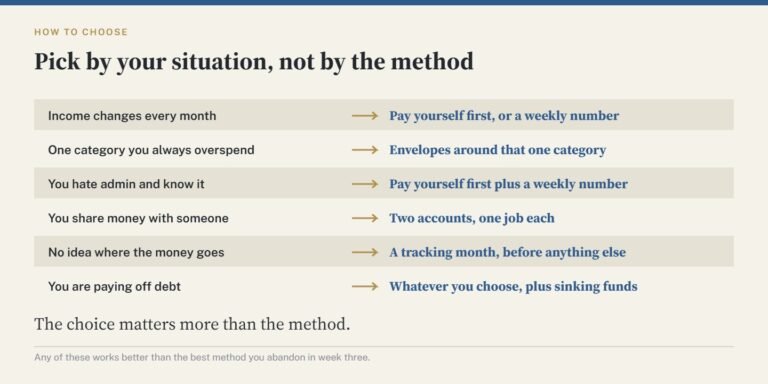
Most people who quit budgeting didn’t fail at math. They picked a budget template that didn’t fit how their money actually arrives. A template built for one steady paycheck falls apart when income comes in twice a month at different amounts, and a 40-line spreadsheet is abandoned the first week it takes longer than ten minutes.
So before the layouts, one question: how does money come into your household? Once you know that, the right template mostly picks itself.
We’re not financial advisors. This is general information to help you organize your own numbers.
A Budget Template Has to Match How You Get Paid
Every budget template answers the same three questions: what’s coming in, what’s going out, and what’s left for goals. The difference is the order and the timing. A monthly template looks at the whole month at once. A paycheck template looks at each paycheck separately. An irregular income template starts from the lowest month you can expect, not the average.

1. What a budget template needs
Whatever the format, a template needs five parts:
- Income: every source, with the date it arrives.
- Fixed costs: rent or mortgage, utilities, insurance, phone, debt minimums. The bills that don’t change much.
- Variable costs: groceries, gas, household, personal spending.
- Savings and goals: emergency fund, extra debt payments, sinking funds.
- A check line: income minus everything above. If it isn’t zero or positive, the plan doesn’t work yet.
Anything beyond those five is optional. Categories can always be added later; a template that starts too detailed rarely survives February.
2. The simple monthly template
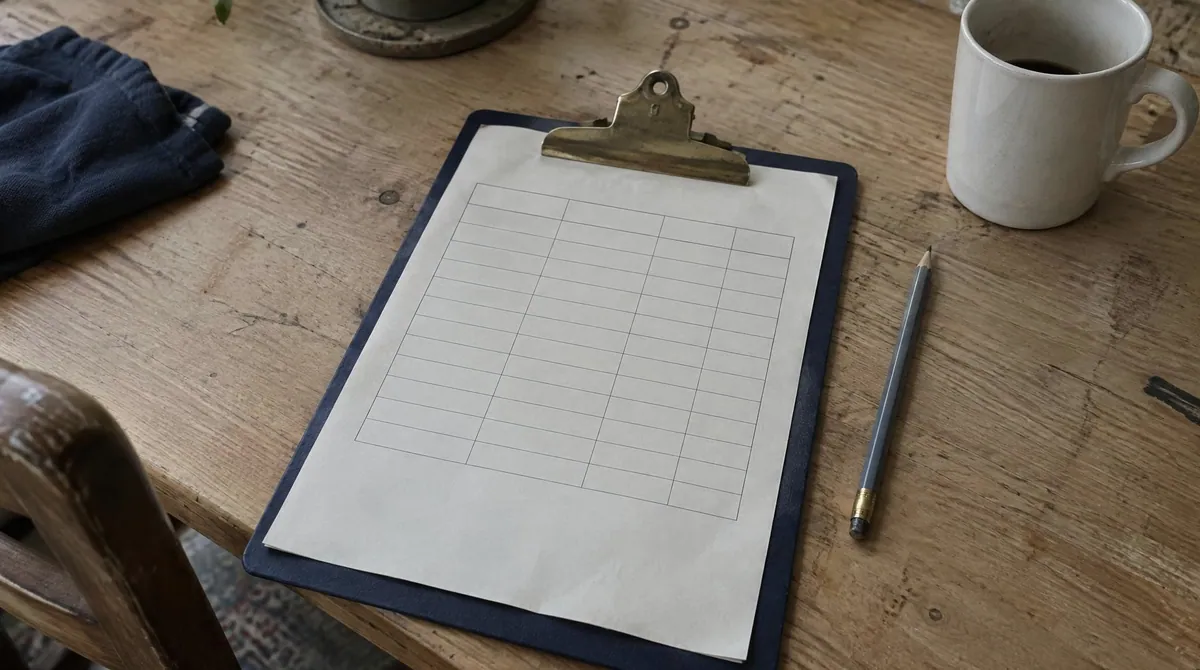
This is the one most people should start with. One page, one month. Income at the top, fixed costs below it, then variable costs and savings. At the bottom, the check line.
It works best if your income is roughly the same every month. Fill it in on the last weekend of the previous month, check it once a week, and compare at the end. Three months of filled-in sheets show your real spending better than any estimate.
3. Zero-based template
A zero-based budget gives every dollar a job until income minus expenses equals zero. Zero doesn’t mean an empty account. It means the money left over is assigned too, to savings, a sinking fund or extra debt payments.
The template looks like the monthly one, but the check line must land exactly at zero. That forces decisions: if there’s $180 left, you choose where it goes before the month starts instead of finding out in week three where it went.
It takes more attention than the simple version. It also tends to find money, because unassigned money is the money that disappears.
4. 50/30/20 template
The 50/30/20 rule splits take-home pay into three buckets: about 50% for needs, 30% for wants and 20% for savings and debt beyond the minimums. The template has three sections instead of a long list.
On $4,000 a month after tax, that’s $2,000 for needs, $1,200 for wants and $800 for savings. In places with high rent, needs often take more than half. That doesn’t make the template useless; it shows you where the pressure is. Our guide to the 50/30/20 budget goes through what counts as a need and what to do when the numbers don’t fit.
5. Paycheck-to-paycheck template
If you’re paid every two weeks, a monthly template hides a timing problem: rent may be due before the second paycheck arrives. A paycheck template splits the month into two columns, one per paycheck, and assigns each bill to the paycheck that will pay it.
Write the due date next to each bill. Put the big ones, usually rent, against the paycheck that arrives before them. Whatever is left in each column covers groceries and variable spending until the next check.
Twice a year, a biweekly schedule produces a month with three paychecks. Plan that third one in advance; it’s the easiest money to put toward savings or debt.
6. Irregular income template
For freelancers, commission, tips or seasonal work, the average month is a trap. Budgeting on the average means overspending in good months and borrowing in bad ones.
The irregular income template starts from a floor: what the household needs in a lean month, covering fixed costs and basic variable costs only. Pay that floor first every month. Anything above it goes in a fixed order: first a buffer that can cover a lean month, then savings, then extras.
A simple rule many people use: keep the income in one account and pay yourself the same amount every month from it, like a salary. The ups and downs stay in that account instead of your checking.
7. Our free printable
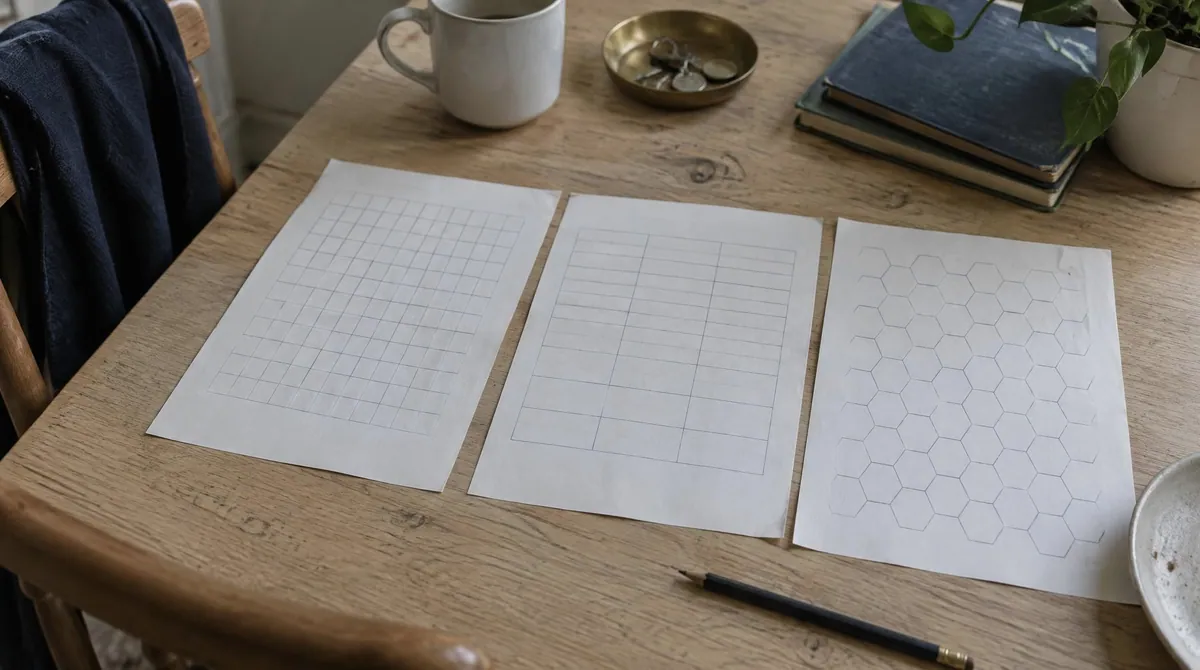
Our own template is the One-Page Month. It’s free, has nothing to sign up for, and prints on Letter or A4 straight from the browser. It’s built around the floor idea from the irregular income template: fixed costs and set-aside savings together form the floor, and everything above it is a decision.
It also has one line left blank on purpose. Every month contains something you didn’t plan for, and a budget with no room for that breaks the first time it happens.
If you’d rather have more pages, our free budget planner article covers the five pages that are enough for most households.
8. What we would skip
Templates with daily spending logs. A weekly check-in catches the same problems with a seventh of the effort.
Dozens of categories. Fifteen lines is plenty for most households; more than that and you’ll spend the check-in deciding where the coffee goes.
Color-coded spreadsheets with formulas you didn’t write. When something breaks, you won’t know why, and you’ll stop using it.
Paper, Spreadsheet or App?
Any of them works. The best format is the one you’ll open every week.
| Format | Good for | Watch out for |
|---|---|---|
| Printed sheet | Seeing the whole month at once, couples budgeting together | Needs to be filled in by hand each month |
| Spreadsheet | Totals that add up automatically, history over months | Easy to overbuild |
| Budgeting app | Automatic transaction import | Subscription cost, less deliberate |
If you’re unsure, start on paper for three months. Once you know which categories you actually use, a spreadsheet is easy to set up and won’t need rebuilding.
What We Would Skip
Copying someone else’s percentages exactly. The point of a template is to show your numbers, not theirs.
Budgeting to the cent. Rounding to the nearest $5 or $10 makes the sheet faster to fill in and loses nothing important.
Starting with a perfect template. A rough one you use beats a detailed one you don’t.
Where We Would Start
Pick the template that matches how you’re paid: monthly if your income is steady, paycheck columns if you’re paid every two weeks, the floor method if it varies. Print it, fill in last month from your bank statement, then plan next month on the same sheet.
If you’re new to all of this, our budgeting for beginners guide walks through the first month step by step.
Questions We Get Asked
What is the simplest budget template?
A one-page monthly sheet with income, fixed costs, variable costs, savings and a check line at the bottom. It covers everything a household needs and takes about ten minutes a week.
Is a zero-based budget template better than 50/30/20?
Neither is better in general. Zero-based gives more control and suits people who want to assign every dollar. 50/30/20 is quicker and works as a rough guide. Some people start with 50/30/20 and move to zero-based once they know their numbers.
How do I make a budget template for irregular income?
Start with your floor, the lowest amount the household needs in a lean month, and budget that first. Put any income above the floor toward a buffer, then savings and extras, in a fixed order.
Should I use a budget template weekly or monthly?
Plan monthly and check weekly. Planning once a month keeps the big picture, and a short weekly check catches overspending while there’s still time to adjust.
What categories should a budget template have?
Housing, utilities, transportation, insurance, debt payments, groceries, personal spending, savings and one line for irregular expenses. Add categories only when one of them keeps getting too big to understand.
Is there a free printable budget template?
Yes. Our One-Page Month is free, prints on Letter or A4 and needs no sign-up.