
The 50 30 20 Budget, Worked Through on a Real Paycheck
The 50/30/20 rule is the simplest budget there is. Half of take-home pay goes to needs, 30 percent to wants and 20 percent to savings and debt repayment. Three numbers, no spreadsheet. It’s popular because it’s easy to start, and it’s criticized because in many expensive cities needs alone take more than half.
Both are true. This article explains the rule, works through a real example and shows what to do when the numbers don’t fit. It’s general information; we’re not financial advisors.
The 50 30 20 Budget in One Paragraph
Take your monthly income after taxes. Multiply by 0.5 for needs, 0.3 for wants and 0.2 for savings and extra debt payments. Track spending into those three buckets. That’s the entire method, popularized by Elizabeth Warren and her daughter Amelia Warren Tyagi in their book All Your Worth.
1. What the 50/30/20 rule says
The rule works on take-home pay, the amount that actually arrives in your account after taxes and any automatic deductions. If your employer takes retirement contributions out before your paycheck, some people count those as part of the 20 percent.
2. What counts as needs
Needs are the expenses you’d have to pay even in a hard month: rent or mortgage, utilities, basic groceries, insurance, transportation to work, minimum debt payments and essential childcare. The test is whether skipping it would cause serious harm or break a contract.
A phone plan is a need. The newest phone isn’t.
3. What counts as wants
Wants are everything else you spend on: eating out, streaming, hobbies, travel, clothes beyond the basics, gym memberships, upgrades. The 30 percent isn’t a reward for being good. It’s what makes the budget livable, and cutting it to zero is the fastest way to abandon a budget.
4. The 20 percent

The 20 percent goes to your future: an emergency fund, retirement contributions, other savings goals and payments on debt above the minimum. Usually in this order: a starter emergency fund, any employer retirement match, high-interest debt, then the rest.
5. Worked example
Take-home pay of $4,200 a month:
| Bucket | Share | Amount |
|---|---|---|
| Needs | 50% | $2,100 |
| Wants | 30% | $1,260 |
| Savings and debt | 20% | $840 |
If rent is $1,500, utilities $180, insurance $120, groceries $400, car payment and gas $250 and phone and internet $150, needs come to $2,600. That’s $500 over the 50 percent line, or about 62 percent of take-home pay. Which is common.
6. When 50 percent isn’t enough

In the example, needs take $2,600. Something has to give. The usual approach is to keep savings as high as possible and trim wants: $1,000 for wants (about 24 percent) and $600 for savings (about 14 percent). That’s not failure. It’s a realistic plan, and it shows exactly where the pressure is.
Over time, the goal is to bring needs down: a cheaper phone plan, refinancing insurance, a roommate or a move at the end of a lease.
7. Adjusting the split
The rule is a starting point, not a law. Common variations:
- 60/20/20 or 70/20/10 for high-cost cities.
- 50/20/30 for someone aggressively paying off debt or saving for a home.
- 80/20: only track savings; everything else is spending.
Pick the split that matches your situation now, and move it toward more savings as income or costs change.
Applying It to an Irregular Income
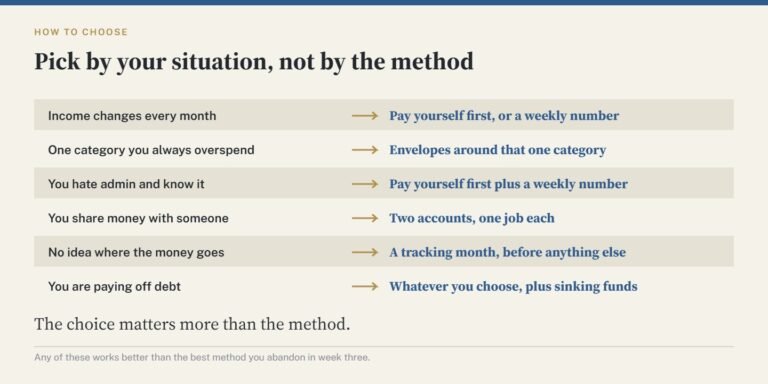
The 50/30/20 rule assumes a steady paycheck. With freelance, commission or seasonal income, a small change makes it work:
- Base the budget on a low month, the lowest typical monthly income from the past year.
- Apply 50/30/20 to that base to set fixed amounts for needs, wants and savings.
- In better months, the extra goes straight to savings or debt, not to wants. Over a year, the actual savings rate ends up much higher than 20 percent.
- Keep a larger buffer, often one month of needs, in a separate account to cover low months.
Example: if your lowest month is $3,000, plan for $1,500 needs, $900 wants and $600 savings. In a $4,500 month, the extra $1,500 goes to savings too, and that month’s savings rate is $2,100, or about 47 percent.
What We Would Skip
Counting all groceries as needs. Basic groceries are needs; takeout and premium snacks are wants.
Abandoning the rule because needs are over 50 percent. Adjust the split instead.
Using gross pay. The rule works on take-home pay.
Where We Would Start
Take last month’s bank statement, sort each expense into needs, wants or savings and see what your real split is. Then set a target split for next month. Our budgeting for beginners guide covers the first month in detail, and our free budget planner has room for all three buckets.
Questions We Get Asked
What is the 50/30/20 rule?
A budget that splits take-home pay into 50 percent for needs, 30 percent for wants and 20 percent for savings and debt repayment.
Is the 50/30/20 rule realistic?
It’s a useful starting point. In high-cost areas, needs often exceed 50 percent, so many people adjust the split.
Does rent count as a need in the 50/30/20 budget?
Yes. Housing is the largest need for most households.
Is debt repayment part of the 20 percent?
Minimum payments are needs. Payments above the minimum count toward the 20 percent.
Who created the 50/30/20 rule?
It was popularized by Elizabeth Warren and Amelia Warren Tyagi in the book All Your Worth.
Does the 50/30/20 rule work with irregular income?
Yes, if you base it on a low typical month and send any extra income in good months straight to savings or debt.