A Free Budget Planner, and the Five Pages It Actually Needs
Most budget planners fail for the same reason: they have too many pages. A planner with daily spending logs, mood trackers, meal plans and 40 categories looks thorough in January and sits in a drawer by March. The pages that actually get used are the ones that take five minutes.
This article covers what a budget planner has to do, the five pages that are enough for most households, and where to find our free printable version. We’re not financial advisors; this is general information to help you organize your own numbers.
A Budget Planner Has One Job: Make the Month Visible
A budget planner doesn’t save money. It shows you where money goes so you can decide whether that’s where you want it to go. Everything in a planner should serve one of three questions: what’s coming in, what’s going out, and what’s left for goals.
If a page doesn’t answer one of those, it’s optional.
1. What a budget planner has to do
A useful planner does four things. It lists income for the month. It lists every expected expense before the month starts. It gives you a place to check actual spending against the plan once a week. And it tracks progress toward one or two goals, like an emergency fund or paying off a card.
That’s it. Anything more is a preference, not a requirement.
2. The one-page month

The core page. Income at the top, then fixed expenses (rent, insurance, phone), then variable expenses with a planned amount (groceries, gas, eating out), then savings and debt payments. At the bottom, income minus everything. If that number is negative, the plan changes before the month starts, not at the end.
Our budgeting for beginners guide explains how to fill it in for the first time.
3. A weekly check-in page
Once a week, ten minutes: add up what you’ve spent in each variable category and compare it to the plan. A simple table with four or five columns, one per week, is enough. Weekly is frequent enough to correct course and not so frequent that it becomes a chore.
4. Sinking fund tracker
A sinking fund is money set aside each month for a known, irregular expense: Christmas, car repairs, annual insurance. A tracker page lists each fund, the target, the monthly amount and the running total. It prevents the “surprise” bills that aren’t really surprises.
5. Debt payoff page
If you have debt, one page lists every balance, interest rate and minimum payment, and shows which one gets the extra payment. Crossing off balances is motivating. Our guide on how to pay off debt compares the avalanche and snowball methods with real numbers.
6. Paper, binder or spreadsheet
A spreadsheet does the arithmetic for you and is easy to adjust. Paper is slower but many people find they look at it more often, and writing numbers by hand makes them feel more real. A binder works well for paper because pages can be added and removed.
There’s no right answer. Use the one you’ll actually open every week.
7. Our printable planner
Our free one-page budget planner is designed to print on one sheet, in US Letter or A4. It covers the one-page month with space for income, fixed and variable expenses, savings and a running total. Print one per month, or print a few and keep them in a binder.
No sign-up and no email address needed.
Filling In the First Month
The first month is the hardest, because you’re guessing at numbers you’ve never written down. A practical way through it:
- Income: write your take-home pay for the month, not your salary. If income varies, use the lowest month of the last six.
- Fixed expenses: copy them from last month’s bank statement: rent, insurance, phone, internet, subscriptions, loan payments.
- Variable expenses: for groceries, gas and eating out, add up the last two or three months and take the average. That’s the starting estimate.
- Savings and debt: decide on an amount, even a small one, and write it as if it were a bill.
- Subtract. If the result is negative, reduce variable categories first, then look at fixed ones.
- Leave a small line called “miscellaneous” for the things you forgot. Most people forget something in the first month.
At the end of the month, compare plan to reality. The second month’s plan will already be much closer.
What We Would Skip
Daily spending logs, unless you’re tracking a specific problem. Weekly totals are enough for most people.
More than about 15 categories. Detail makes the planner harder to keep up.
Expensive printed planners before you know which pages you use.
Starting mid-month. Begin on the first, or plan the rest of the current month as a short trial.
Where We Would Start
Print the one-page month and fill it in before the next month begins. Add the weekly check-in in the second week. Add the sinking fund and debt pages only when the first two have become a habit.
If the budget shows less room than you expected, our money saving tips and frugal living tips are good next reads.
Questions We Get Asked
What should be in a budget planner?
Income, fixed expenses, variable expenses with planned amounts, savings and debt payments, and space to compare actual spending once a week.
Is a paper or digital budget planner better?
Neither is better in general. Spreadsheets calculate for you; paper is often looked at more. Choose the one you’ll use every week.
How do I start a budget planner?
Before the month starts, list all income and every expected expense, then subtract. Adjust until the result is zero or positive.
How often should I update my budget planner?
Once a week for spending, once a month for the full plan.
Is your budget planner really free?
Yes. It’s a printable page on our site with no sign-up.
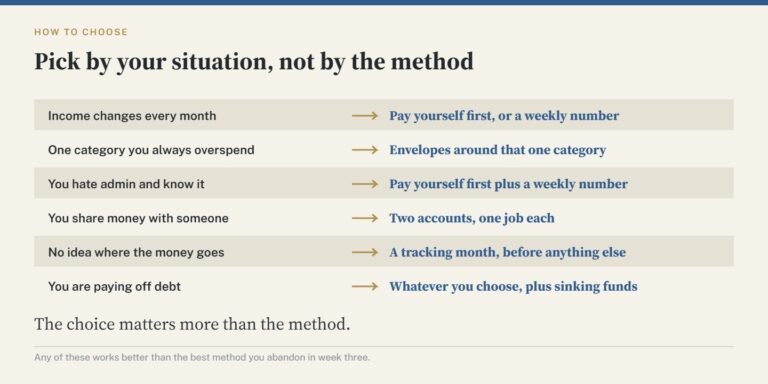
What if my income changes every month?
Plan using your lowest typical month. In better months, put the extra toward savings or debt rather than raising spending.