10 Budgeting Methods for Beginners, and How to Pick One
The reason most budgeting advice does not help is that it assumes the problem is not knowing how. It usually is not. The problem is that the method you picked does not fit the way your money actually arrives and leaves.
We have used most of these. Some lasted years, some lasted eleven days. What follows is what each one is genuinely good at, what it is bad at, and who it tends to work for – followed by the part nobody writes, which is how to choose.
Budgeting for Beginners: Ten Methods Worth Knowing
1. Zero-based budgeting
Every dollar that arrives gets assigned a job before the month starts, until nothing is unassigned. Savings and debt payments count as jobs.
Good at: making you confront trade-offs directly, because there is nowhere for a dollar to hide. Bad at: variable income, and at forgiving a month that goes sideways. Suits people who like a system and will sit down with it once a month.
2. The 50/30/20 rule
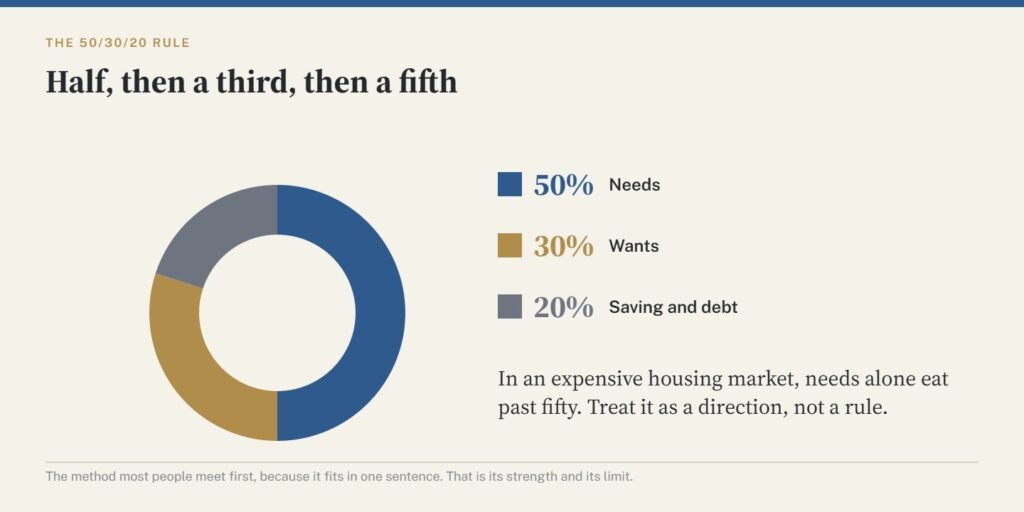
Half to needs, thirty percent to wants, twenty to saving and debt. It is the one most people meet first, because it is a single sentence.
Good at: giving you a shape when you have none. Bad at: expensive housing markets, where needs alone eat far past fifty. Treat the numbers as a direction, not a rule, and the method survives.
3. Cash envelopes
Withdraw cash, divide it into envelopes by category, spend only what is in the envelope. When it is empty, that category is closed until next month.
Good at: overspending in one or two specific categories. Bad at: everything online, and at anyone who finds carrying cash impractical. The reason it still works is friction: handing over notes is a slower act than tapping a card.
4. Cash envelopes without the cash
The same idea in separate accounts or a banking app that supports pots. Groceries has its own balance and you can see it fall.
Good at: most of the benefit with none of the ATM trips. Bad at: it is easier to move money between pots than to move it between envelopes, which is exactly the discipline the original relied on.
5. Pay yourself first
Decide the savings number, move it on payday, then live on what is left. Everything after that is unbudgeted.
Good at: actually saving, which is a lower bar than it sounds and the one most methods fail. Bad at: telling you anything about where the rest goes. Often the right first method, because it works even if you never look again.
6. The anti-budget
One number to stay under, per week, for everything that is not a fixed bill. No categories at all.
Good at: people who will not maintain a spreadsheet and know it. Bad at: diagnosing a problem – if the number is always blown, this method will not tell you why.
7. Two accounts, one job each
Income lands in an account that pays only bills and savings. A fixed amount moves weekly into a second account, and that one is for spending. When it is empty, the week is over.
Good at: removing the daily decision entirely, which is where most budgets fail. Bad at: irregular bills, unless you pair it with sinking funds. This is the one we kept.
8. Sinking funds
Not a budget on its own, but the piece most budgets are missing. Known irregular costs – the car service, the December, the dentist – divided by the months until they land and set aside monthly.
Good at: stopping the pattern where four good months are undone by one predictable bill. Bad at: nothing much. Add this to whatever else you choose.
9. The values budget
Write down the three or four things you genuinely want money to buy you. Fund those first and generously, cut everything outside them harder than feels reasonable.
Good at: making frugality bearable, and at ending the guilt that attaches to ordinary spending. Bad at: people who have not thought about it, because the method is mostly the thinking. There is more on that in our frugal living tips.
10. The tracking month
Not a budget. For one month, write down everything and change nothing. At the end you have the shape of your spending, which is the input every other method needs.
Good at: first months, and at settling arguments. Bad at: being mistaken for a solution – tracking forever is admin, not budgeting.
How to Actually Choose
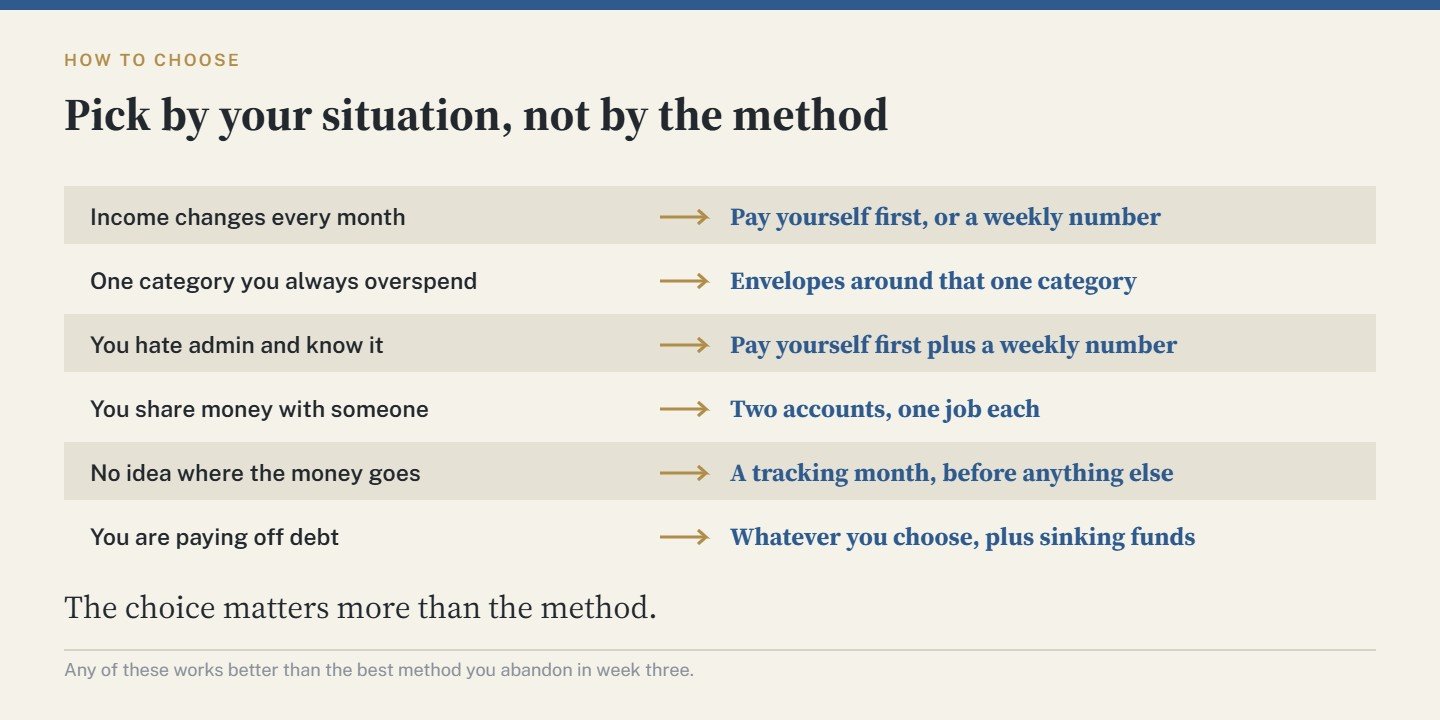
Most guides stop at the list. The choice matters more than the method, so:
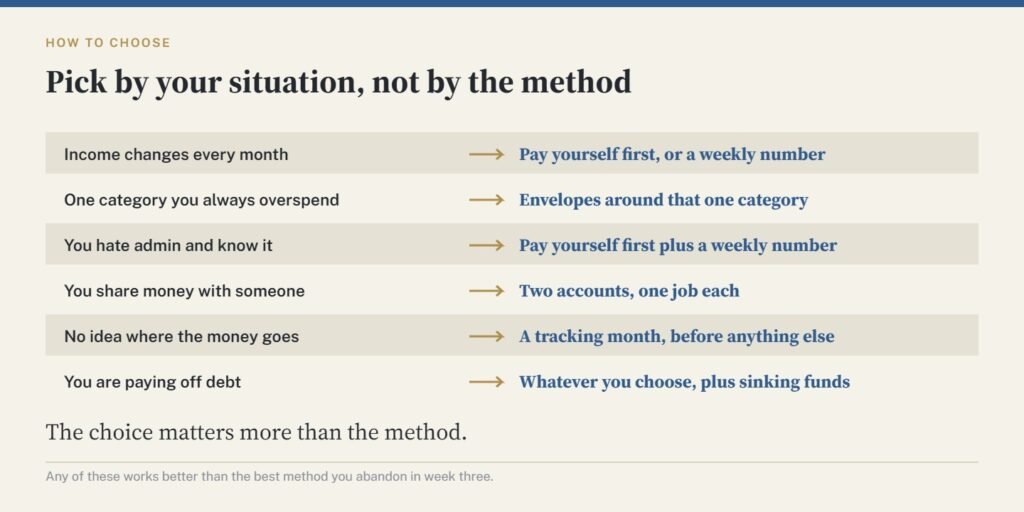
If your income changes month to month, budget the floor rather than the average. Use the lowest month of the last year as your planning number, and treat anything above it as a windfall that goes to the buffer first. Zero-based budgeting fights you here; pay-yourself-first and the anti-budget do not.
If you overspend in one obvious category, you do not need a whole system. Put envelopes, real or digital, around that one category and leave the rest alone.
If you hate admin, take pay-yourself-first plus a weekly number. Two decisions a month, no categories, no spreadsheet. It is less precise and you will still be using it next year.
If you share money with someone, pick the method with the fewest daily decisions, because every decision is a negotiation. The two-account setup tends to survive this best.
If you have no idea where the money goes, start with the tracking month. Choosing a method before you know your own numbers is guessing.
If you are paying off debt, whatever you choose, pair it with sinking funds. The most common reason a payoff plan stalls is not weak willpower – it is a predictable bill that nobody budgeted for.
What We Would Skip
Apps that need every account connected before they tell you anything. Budgets with more than about eight categories, which turn into data entry. Anything that requires you to be more organized in March than you were in January.
And any method that has no answer for a bad month. Bad months are not the exception, they are the test.
Where We Would Start
The tracking month, then pay-yourself-first, then add sinking funds when a surprise bill has annoyed you enough. That sequence takes about three months and skips most of the failure modes.
If you want somewhere to put the numbers, we made a budget planner that fits on one page – it is built around the two-account method but works with most of the others.
If you are not sure which method fits yet, a month of tracking tells you more than a method does — and so does a no spend challenge, which is really a diagnostic test with a motivating name.
Questions We Get Asked
Which budgeting method is best for beginners?
Pay yourself first, in most cases. It has one decision, it works even when you ignore it, and it produces the outcome people actually want, which is having more money later. Zero-based budgeting is more powerful and more likely to be abandoned in week three.
How long before a budget starts working?
About three months, in our experience, and the first one is mostly noise. Month one you find out what you actually spend, month two you overcorrect, month three is the first honest number. Judging the method before then is judging the wrong thing.
How many categories should a budget have?
Fewer than you think. Five to eight covers most households: housing, food, transport, bills, saving and debt, and one line for everything else. Detailed categories feel thorough and quietly turn budgeting into bookkeeping.
What if I blow the budget every month?
Then the budget is wrong, not you. A plan you miss every month is a plan built on a number you do not actually live on. Rebuild it from what you spent last month rather than what you hoped to spend.
Do I need an app?
No. Every method here works on paper, and paper has the advantage of being slow. If you want an app, pick one that works when you do not connect your accounts, because the day the connection breaks is the day most people stop.