
12 Frugal Living Tips That Do Not Feel Like Sacrifice
We once went four months without buying anything that was not food. It worked, in the sense that the numbers moved. It also made us miserable and slightly boring to be around, and within six weeks of stopping we had spent most of it back on things we did not want very much.
What actually stuck was smaller and less dramatic. A handful of changes that we stopped noticing after a few weeks, which is the only real test of a frugal living tip. If you are still bracing against it in month three, it is not a habit, it is a diet.
These are the twelve that survived.
Frugal Living Tips That Survive Past the First Month
The ones below are in rough order of how much they moved the number. That order will surprise you if you have read a lot of frugal living advice, because the famous ones – the coffee, the lunch, the brand-name swaps – are near the bottom. They are not wrong. They are just small, and they cost you attention you could spend on something bigger.
1. Cancel it first, then see whether you miss it
The usual advice is to audit your subscriptions and decide which ones you value. We are terrible at that decision in the abstract. We keep things because cancelling feels like admitting we wasted the last eleven months.
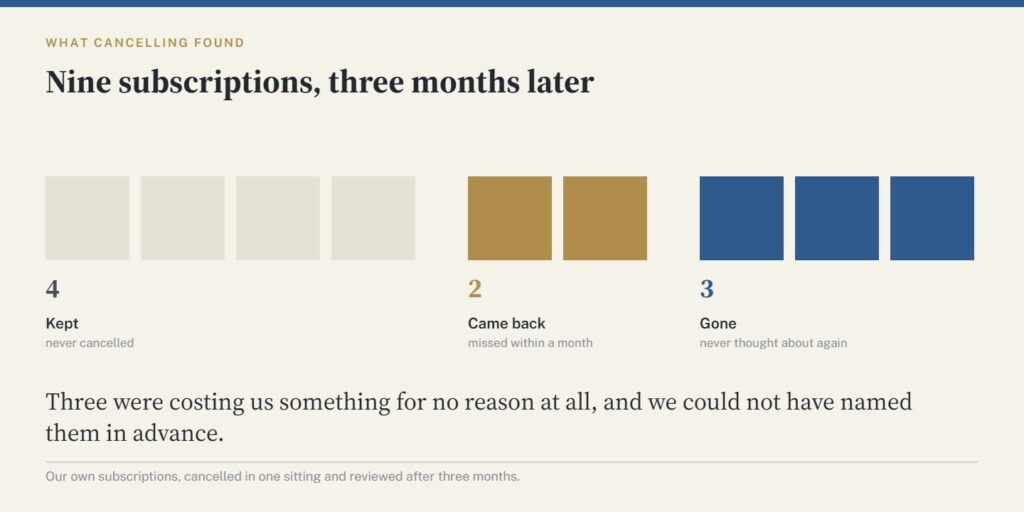
Cancel it and find out. Most services will let you back in at the same price, and several will offer you a lower one. In our case, five of nine went and two came back within a month, which means three had been quietly costing us something for no reason at all.
2. Buy the boring version of things you use every day
Not the cheapest version. The boring one. The unbranded olive oil, the supermarket painkillers with the same active ingredient, the plain white shirt. These are the purchases where paying more buys you almost nothing, and they happen weekly, so the gap compounds.
The opposite applies to things you use every day that take physical punishment – shoes, a knife, a coat, a mattress. There the cheap version is a subscription you pay every eighteen months.

3. Keep a list of what you nearly bought
One note on your phone. Every time you close a tab without buying, write the thing and the price. No rules, no commitment, nothing to resist.
What happens is that after a month you have a list, and roughly nine out of ten items on it read as slightly absurd. The list does two things: it makes the impulse visible, and it gives you somewhere to put it that is not a checkout.
4. Cook the same five meals
Variety is not what makes food enjoyable on a Wednesday. Having a decision already made is. Five meals you can cook without looking anything up means a shopping list that does not change much, ingredients that overlap, and almost no food thrown away.
We rotate five and add a sixth when we get bored. The savings are not in eating cheaply. They are in not standing in a supermarket at half past six with no plan.

5. Spend money on the thing that stops three other costs
A decent thermos ends the daily coffee without any willpower involved. A library card ends most book buying. A bike replaces some of the fuel and all of the gym. A good pair of boots ends the annual boot purchase.
This is the one piece of frugal living advice that involves spending more, and it is the one we would keep if we could only keep one. Look for purchases that remove a recurring line rather than reduce it.

6. Put seventy-two hours between wanting and buying
For anything above a threshold you set yourself – ours is roughly the price of a nice dinner. Put it in the basket, leave it, come back on Friday.
The point is not self-denial. The point is that wanting something is a feeling with a half-life, and three days is usually longer than the half-life. The things you still want on Friday are the things worth buying, and buying those without guilt is what makes the rest of this sustainable.
7. Stop optimizing the small stuff and look at three lines
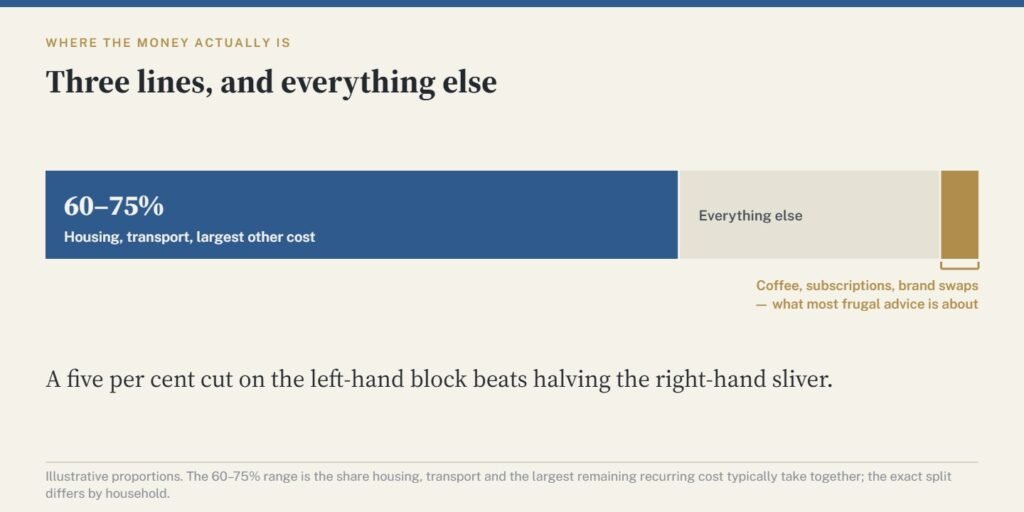
Housing, transport, and whatever your largest recurring cost is. For most people those three are somewhere between sixty and seventy-five percent of everything that leaves the account.
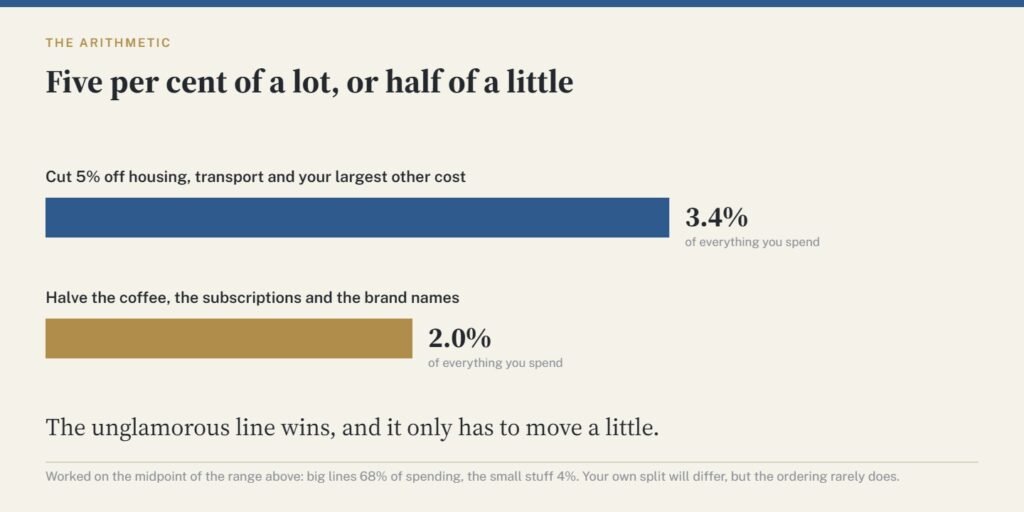
Nobody wants to look there, because the answers are uncomfortable and slow – move, downsize, change how you get to work, refinance. But those lines are so large that a five percent cut on them beats halving the things most frugal living content is actually about. Coffee, subscriptions and brand swaps together rarely add up to more than a few percent of the total. If you want the arithmetic laid out, it is in our notes on money saving tips.
8. Give yourself one annual hour
Once a year, one hour, one sitting: insurance, phone, broadband, energy, any subscription with a renewal date. Call or switch.
It is dull and it is worth more per hour than almost anything else on this list, because these companies price on the assumption that you will not. Put it in the calendar on a fixed date so it does not become a decision.
9. Learn one repair, not all of them
Everyone who writes about frugal living eventually tells you to fix things yourself. In practice, learning to repair everything is a hobby, not a saving.
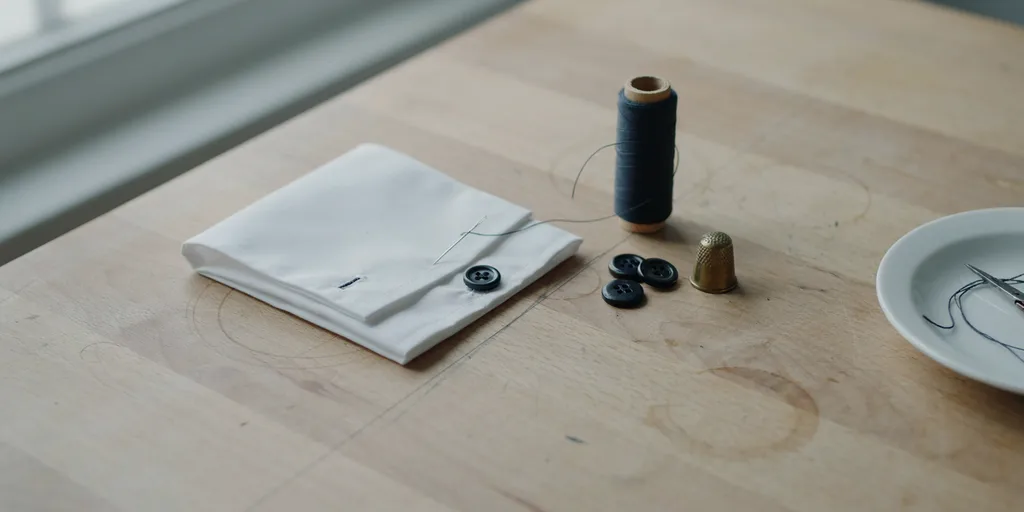
Pick one. Sewing a button and taking up a hem covers a surprising share of the clothes people replace. Or bike maintenance. Or basic plumbing. One thing, learned properly, used often.
10. Keep a category called “this was worth it”
Not a treat fund, not a reward. A line in the budget for the things you would buy again at double the price.
Frugality without this line fails, and it fails at about month five, in a pattern most people recognize: a long careful stretch followed by one expensive weekend that undoes it. A permitted expense is cheaper than a rebound. This is also the easiest line to defend when someone asks why you bother with any of this.
11. Buy secondhand for the things that already survived
A twelve-year-old cast iron pan, a solid wood table, a bike frame, a wool coat. These items have passed a test that a new equivalent has not: they still exist.
Secondhand works badly for anything with a battery, a seal or a motor, and it works badly for shoes. It works extremely well for furniture, which is also where the new prices are most inflated.

12. Tell one other person the number
Not the whole plan. One number – what you want to have by a date, or what you are trying to keep monthly spending under.
Said out loud to someone who will remember, it stops being an intention. We have no elegant explanation for why this works as well as it does, only that in our experience the months we told someone went differently from the months we did not.
What We Would Skip
Extreme grocery challenges. Reusing tea bags and similar tips that trade real discomfort for pennies. Anything framed as a hack. Apps that round up your change, which feel productive and move roughly nothing.
Also, most advice that starts with the word “just”. Just move somewhere cheaper. Just get a better job. These are not tips, they are circumstances, and the people giving them usually already had them.
And any version of frugality that requires you to be at war with yourself. That version has a failure date built in – you just cannot see it from month one.
Where We Would Start
Number one and number eight, in that order, this week. Both are a single sitting, both are reversible, and between them they usually find more than the next six items combined.
Then leave the rest alone for a month. The list is not a program to complete. It is a set of things that turned out to be sustainable, and sustainability is the entire point.
If you want somewhere to write the numbers down, we made a budget planner that fits on one page. And the case for building a buffer before optimizing anything is in our notes on the emergency fund.
Questions We Get Asked
What is the difference between frugal and cheap?
Frugal is about what you get for the money; cheap is about the money alone. Buying a coat that lasts ten years is frugal and not cheap. Buying four coats that each last two winters is cheap and not frugal. The distinction matters because most people who give up on frugal living gave up on the cheap version.
How much can frugal living actually save?
Honestly, less than the headlines suggest, unless you touch housing or transport. The small habits on this list moved our monthly spending by something in the range of ten to fifteen percent, which is real money and is not life-changing. The three big lines in tip seven are where the life-changing numbers live.
Do I have to track every expense?
No, and we stopped. Tracking everything is useful for about two months, because it tells you where the money goes, and after that it is mostly admin. Once you know the shape of your spending, a weekly number to stay under does the same job with a fraction of the effort.
What if my income is different every month?
Budget the floor rather than the average. Work out the lowest month of the last year and plan against that number; anything above it goes to the buffer first and the “worth it” line second. Averaging is what makes variable income feel like failure three months out of twelve.
Where do the books come in?
Occasionally. Most personal finance books say one useful thing padded to two hundred pages, and we will tell you which page it is on. That is a different post.