
10k Savings Challenge: Weekly, Biweekly and Monthly Versions
Ten thousand dollars sounds like a different kind of number from a few hundred. Broken into pieces, it’s not. The 10k savings challenge is simply a way to split the total into steps small enough to tick off, so the progress is visible long before the end.
Below are four ways to do it, with exact amounts, so you can pick the one that matches how you get paid.
We’re not financial advisors. This is general information to help you organize your own numbers.
How the 10k Savings Challenge Works
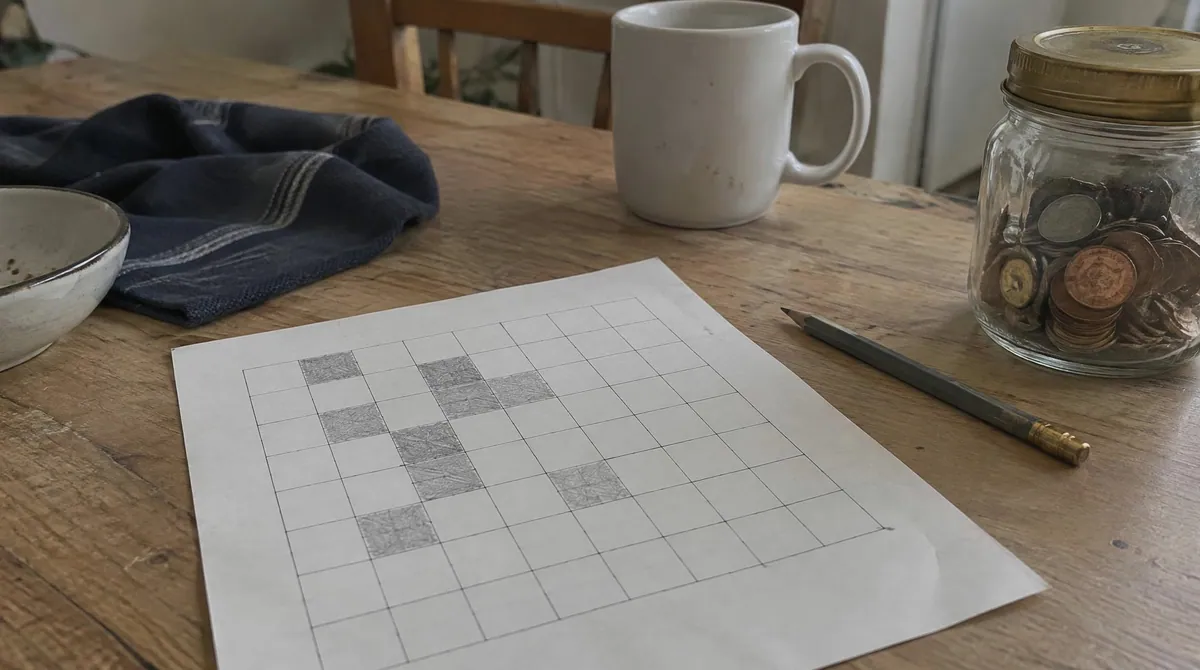
You pick a time frame, usually one or two years, and a rhythm: weekly, every paycheck or monthly. Each step has a fixed amount, and you shade in a box on a chart every time you make it. When every box is filled, you’ve saved $10,000.

1. What $10,000 takes
| Time frame | Per week | Per biweekly paycheck | Per month |
|---|---|---|---|
| 1 year | $192.31 | $384.62 | $833.33 |
| 18 months | $128.21 | $256.41 | $555.56 |
| 2 years | $96.15 | $192.31 | $416.67 |
| 3 years | $64.10 | $128.21 | $277.78 |
Look at that table against your monthly budget before choosing. For many households, one year is too steep. Two or three years is still a 10k savings challenge, and it’s one you’re more likely to finish.
2. Weekly version
52 deposits. For a one-year challenge, $192.31 a week; most people round to $195 and finish a week or two early.
The weekly version suits people who are paid weekly or who like a short, frequent habit. The chart has 52 boxes, and filling one in every Friday is satisfying in a way a monthly transfer isn’t.
3. Biweekly version
26 deposits, timed with each paycheck. For one year, $384.62 per paycheck; for two years, $192.31.
This is the easiest version to automate if you’re paid every two weeks. Set the transfer for payday and the challenge runs without you. The two months a year with three paychecks don’t change anything, because the deposit follows the paycheck, not the calendar.
4. Monthly version
12 deposits a year. One year needs $833.33 a month, two years $416.67, three years $277.78.
Monthly is the simplest to track and the hardest to stick with when money is tight, because each deposit is large. If you choose it, set the transfer for the day after your first paycheck of the month.
5. The 100-envelope route

The classic 100-envelope challenge numbers envelopes from 1 to 100 and adds that many dollars to each one. That totals $5,050.
For $10,000, double it: number the envelopes $2, $4, $6 and so on up to $200. All 100 envelopes add up to $10,100. Pick one or two a week at random and fill them. Some weeks cost $6, some cost $380, and that randomness is the point for people who get bored with fixed amounts.
The downside is cash. Keeping $10,000 in envelopes at home is risky, so most people deposit each envelope’s amount and keep the empty envelope as the record.
6. Where to keep it
In a separate savings account, not in checking and not in a jar once it adds up. A high-yield savings account earns interest along the way; rates change, so compare current offers. Over a year or two, that interest can cover a few of the boxes on the chart for you.
If the $10,000 is for something more than five years away, see our savings plan guide for where longer-term money can go instead.
7. What to do if you fall behind

Don’t double up the next week. That turns one missed deposit into two hard weeks and is usually where the challenge ends.
Instead, divide the missed amount across the remaining weeks. Two missed $195 deposits halfway through a one-year challenge add $15 to each of the 26 weeks left. Or extend the end date by two weeks. Both still get you to $10,000.
8. What we would skip
Starting the one-year version if it means skipping the emergency fund. A challenge that gets raided for a car repair stops being a challenge.
Printing ten different charts. One chart, on the fridge or inside a cabinet door, is enough.
Make It Visible
A printed grid where each square is one deposit works better than a number in an app, because you see the shaded part grow every time you open the fridge. Our saving money chart and savings tracker guides have layouts you can draw by hand in five minutes.
What We Would Skip
Choosing the time frame to impress anyone. Two years at $96 a week finishes; one year at $192 often doesn’t.
Treating windfalls as separate. A tax refund can fill a dozen boxes at once, and that counts.
Quitting after a missed month. Recalculate and carry on.
Where We Would Start
Look at the table, pick the row and column that fits your pay schedule and budget, and round the amount up to the next $5. Set up the automatic transfer for payday, print a grid with the right number of boxes, and shade the first one in today.
Questions We Get Asked
How much do I need to save each week for $10,000 in a year?
$192.31 a week for 52 weeks. Rounding to $195 gets you there about a week early.
Is the 10k savings challenge realistic?
It depends on the time frame. One year takes $833 a month, which is a lot for most budgets. Two or three years, at $417 or $278 a month, is realistic for many households.
How does the 100-envelope challenge reach $10,000?
The standard version, $1 to $100, totals $5,050. Doubling every envelope, $2 to $200, totals $10,100.
Can I do the 10k savings challenge with biweekly pay?
Yes. It’s the easiest version to automate: $384.62 per paycheck for one year or $192.31 for two years, transferred on payday.
Where should I keep the money for a savings challenge?
In a separate savings account, ideally one with a competitive interest rate. Keeping large amounts of cash at home is risky.
What if I miss a week?
Spread the missed amount over the remaining weeks or move the end date back. Doubling up the next week is where most people give up.